


Home » Blog » Physical Therapist vs. Occupational Therapist

OT vs PT: What’s the Difference?

physical therapist helps senior man with walking
author-default

By: All Allied Health Staff

Updated: December 10, 2025

Home » Blog » Physical Therapist vs. Occupational Therapist

Occupational therapist vs. physical therapist. Which career is right for you? Both do vital hands-on rehabilitative work to help patients with injuries or disabilities that limit how they’re able to move and function in daily life.

PTs work primarily with people recovering from injuries. The goal is to get patients back in motion with exercises, massage and other techniques, and therapy usually happens in a PT’s office. Physical therapy often focuses on preventing injuries, and it can help people avoid surgery or a long-term reliance on medications.

OTs help their patients perform day-to-day tasks, whether they’re recovering from injuries or have developmental or cognitive disabilities affecting their motor skills, emotions or behavior. Some occupational therapy might happen in a hospital or OT’s office, but a key component occurs in a patient’s home or work environment. Other OTs work in schools and help children develop skills to become functioning, independent adults.There’s a strong emphasis on the practical aspects of helping people do the things they want and need to do so they can live life to the fullest.
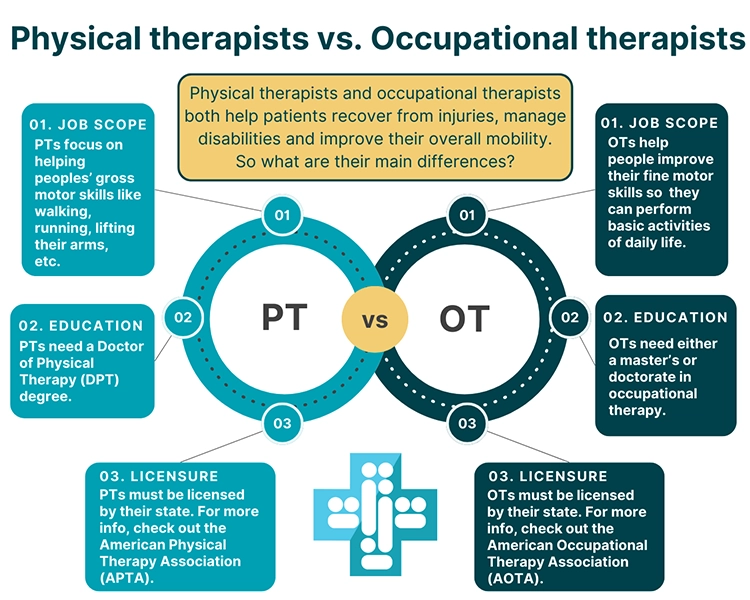
A Venn Diagram explaining the main differences between physical therapists and occupational therapists

The Key Differences

Here’s a comparison between occupational therapist vs. physical therapist professions:

Job Duties


Physical Therapists

  • Diagnose physical problems restricting movement because of an illness or injury
  • Use exercises and other techniques to ease pain and boost mobility and muscle strength
  • Develop fitness and wellness programs aimed at preventing injuries and encouraging a more active lifestyle

Occupational Therapists

  • Help patients with daily living skills and self-care tasks (i.e., “occupations”) such as getting dressed
  • Make recommendations about adaptive and accessibility equipment, such as ramps, wheelchairs, or gait trainers to patients, architects and contractors
  • Support patients with memory loss or other cognitive issues

Education


Physical Therapists

Occupational Therapists

  • Physical therapists need a doctorate degree accredited by the Commission on Accreditation in Physical Therapy Education, which can take about three years to complete.
  • Occupational therapists need at least a master’s degree to practice (about two years). A doctoral degree is also an option and takes between two and three years.

Licensing and Certification


Physical Therapists

Occupational Therapists

  • Physical therapists must be licensed. To sit for the National Physical Therapist Examination, you have to be a graduate of an accredited physical therapy school.
  • Licensing laws vary by state but common requirements include graduating from an accredited occupational therapy school, meeting fieldwork requirements, and passing a national certification exam.

Median Annual Salaries

Your education, years on the job, and location, can play a factor in how much you earn. Compare salaries for PTs and OTs below.

Physical Therapists

National data

Median Salary: $101,020

Projected job growth: 10.9%

10th Percentile: $74,420

25th Percentile: $83,470

75th Percentile: $117,190

90th Percentile: $132,500

Projected job growth: 10.9%

State data

State Median Salary Bottom 10% Top 10%
Alabama $97,040 $68,030 $128,810
Alaska $108,640 $87,080 $135,610
Arizona $101,660 $79,040 $131,380
Arkansas $96,840 $70,990 $129,260
California $123,300 $81,910 $161,230
Colorado $100,240 $70,070 $127,870
Connecticut $103,720 $78,360 $125,340
Delaware $103,120 $80,480 $135,990
District of Columbia $100,760 $84,510 $131,810
Florida $98,880 $60,430 $123,700
Georgia $101,930 $76,450 $131,030
Hawaii $100,740 $81,210 $121,760
Idaho $93,610 $72,180 $122,630
Illinois $103,380 $82,590 $140,670
Indiana $99,310 $69,990 $125,090
Iowa $95,890 $69,990 $116,390
Kansas $98,840 $67,780 $123,700
Kentucky $97,500 $61,810 $121,590
Louisiana $100,550 $65,190 $133,760
Maine $93,890 $74,880 $113,410
Maryland $104,330 $80,940 $133,770
Massachusetts $102,260 $79,930 $128,160
Michigan $98,960 $75,440 $118,940
Minnesota $98,870 $81,630 $115,860
Mississippi $97,080 $66,050 $121,350
Missouri $93,750 $71,150 $119,980
Montana $92,910 $75,880 $112,620
Nebraska $96,540 $76,140 $115,310
Nevada $105,170 $83,680 $149,700
New Hampshire $97,200 $72,460 $115,410
New Jersey $106,310 $80,220 $138,640
New Mexico $101,130 $57,040 $137,040
New York $99,430 $66,680 $130,350
North Carolina $96,670 $72,850 $121,380
North Dakota $86,180 $72,750 $109,620
Ohio $99,740 $75,070 $123,330
Oklahoma $99,220 $66,000 $127,880
Oregon $104,430 $79,610 $129,540
Pennsylvania $99,570 $74,000 $125,810
Rhode Island $102,900 $74,000 $130,180
South Carolina $100,950 $73,420 $119,560
South Dakota $89,240 $67,670 $106,710
Tennessee $100,660 $74,160 $123,800
Texas $103,710 $74,380 $135,390
Utah $97,580 $53,470 $132,970
Vermont $93,840 $77,410 $113,940
Virginia $100,710 $75,830 $129,440
Washington $102,140 $75,040 $134,430
West Virginia $101,210 $70,790 $127,860
Wisconsin $100,440 $78,870 $121,780
Wyoming $101,130 $78,540 $121,780

Source: U.S. Bureau of Labor Statistics (BLS) 2024 median salary; projected job growth through 2034. Actual salaries may vary depending on location, level of education, years of experience, work environment, and other factors. Salaries may differ even more for those who are self-employed or work part time.

Occupational Therapists

National data

Median Salary: $98,340

Projected job growth: 13.8%

10th Percentile: $67,090

25th Percentile: $80,490

75th Percentile: $110,460

90th Percentile: $129,830

Projected job growth: 13.8%

State data

State Median Salary Bottom 10% Top 10%
Alabama $95,410 $73,030 $122,990
Alaska $100,070 $67,280 $134,080
Arizona $102,220 $75,020 $129,010
Arkansas $99,350 $64,480 $141,620
California $119,470 $82,090 $154,800
Colorado $103,970 $79,070 $145,770
Connecticut $102,080 $74,700 $130,680
Delaware $96,080 $64,750 $127,280
District of Columbia $99,290 $78,820 $128,180
Florida $99,070 $73,570 $116,010
Georgia $98,690 $60,530 $125,330
Hawaii $94,550 $80,540 $114,340
Idaho $88,470 $48,840 $117,600
Illinois $98,900 $67,530 $128,810
Indiana $93,500 $63,160 $121,310
Iowa $88,780 $69,560 $115,270
Kansas $97,000 $63,590 $119,100
Kentucky $91,250 $68,140 $115,940
Louisiana $94,030 $56,570 $122,990
Maine $82,200 $63,480 $102,180
Maryland $101,880 $73,570 $129,410
Massachusetts $98,420 $73,020 $122,490
Michigan $84,480 $61,220 $105,710
Minnesota $85,040 $62,790 $105,320
Mississippi $92,330 $68,390 $114,010
Missouri $93,600 $66,460 $113,000
Montana $84,440 $73,840 $106,690
Nebraska $87,010 $73,310 $105,500
Nevada $104,770 $68,330 $150,180
New Hampshire $84,980 $59,770 $108,030
New Jersey $103,340 $66,470 $151,720
New Mexico $99,220 $67,450 $139,150
New York $95,370 $63,120 $139,800
North Carolina $94,580 $64,310 $119,010
North Dakota $79,910 $64,480 $102,900
Ohio $95,880 $67,930 $121,250
Oklahoma $103,510 $74,300 $128,810
Oregon $106,840 $78,730 $128,440
Pennsylvania $94,120 $66,460 $123,090
Rhode Island $99,150 $72,870 $118,660
South Carolina $97,370 $65,530 $115,350
South Dakota $81,430 $61,890 $100,040
Tennessee $96,030 $67,920 $115,280
Texas $101,760 $69,700 $136,380
Utah $93,310 $64,210 $119,450
Vermont $86,420 $67,010 $108,060
Virginia $100,540 $58,440 $133,170
Washington $102,360 $79,810 $130,630
West Virginia $93,260 $56,940 $126,770
Wisconsin $86,660 $71,030 $107,260
Wyoming $89,370 $69,240 $122,930

Source: U.S. Bureau of Labor Statistics (BLS) 2024 median salary; projected job growth through 2034. Actual salaries may vary depending on location, level of education, years of experience, work environment, and other factors. Salaries may differ even more for those who are self-employed or work part time.

What’s Next?


Physical Therapists

Occupational Therapists

  • Seek certification from the American Board of Physical Therapy Specialties after meeting clinical practice requirements by working with patients in a specialty area, such as:
  • Geriatrics
  • Neurology
  • Orthopedics
  • Pediatrics
  • Sports
  • Women’s health
  • OTs can seek board certification in gerontology, mental health, pediatrics, or physical rehabilitation after meeting clinical practice requirements; or specialty certification in:
  • Driving
  • Community mobility
  • Environment modification
  • Low vision
  • Feeding, eating, swallowing
  • School systems

In some cases, patients start out with a physical therapist then move on to an occupational therapist. One example: Someone recovering from a stroke might work with a physical therapist to build back muscle strength. Later on, that person would see an occupational therapist to work on buttoning a shirt, using the restroom or taking a shower.

If you’re interested in either career, there are entry-level educational and career options. Find out more about what it takes to become a physical therapy assistant or an occupational therapy assistant.