

In this Article


Professional insights: Kate Scrivens
Sonographers, also known as ultrasound techs, use ultrasound technology to create medical images of the inner body. These images help physicians and specialists diagnose, treat and monitor patients. Read on to learn how to become an ultrasound tech and get started in this growing field.
Key takeaways
- Sonographers work in hospitals, physician offices, diagnostic laboratories and other healthcare settings, taking diagnostic images to help physicians diagnose and treat numerous medical conditions.
- In order to work as a medical sonographer, you’ll need at least an associate degree in diagnostic medical sonography.
- The employment of medical sonographers is expected to grow 13% through 2034, much faster than the average across all occupations.
What is diagnostic medical sonography?
“As sonographers, we use sound waves to make diagnostic images of the internal body without having to do anything invasive,” explained Kate Scrivens, a sonographer in Central Oregon.
The technology, which doesn’t produce radiation and is considered safe and low-risk, can create images of the vascular system, organs, tissues, joints, muscles and fetuses.
Sonographers provide images, along with their insights and a summary, to a radiologist, who interprets the images. The radiologist or physician who ordered the images delivers the findings to the patient.
Ultrasound can be used to detect many medical problems, including:
- Abnormal growths, such as on the thyroid
- Blockages in arteries
- Tumors, such as cancer of the liver
Ultrasounds are also commonly used during pregnancy to monitor the growth of the fetus and the patient’s reproductive system, as well as to determine if the fetus is male or female.
Learn to become a sonographer/ultrasound tech in 4 steps
There are many reasons you might want to become a sonographer. “I love helping people,” Scrivens said. “And I get to see inside the body, how it works. It’s fascinating.”
Diagnostic medical sonography is a growing field and there are opportunities to specialize as you advance in your career. If you’re thinking about becoming a sonographer, here’s a guide to pursuing a career in this field.
Determine what education you’ll need.

It’s important to consider which educational path is the best choice for you based on your finances, career plans, and personal responsibilities. Your options include an associate degree, which takes two years, or a bachelor’s degree, which takes four. In addition, healthcare professionals who already have a degree and want to move into sonography may do so by earning a certificate, which takes one to two years.
Graduate from an accredited program.

Enrolling in an accredited program at an accredited school lets potential employers know that your education meets the high standards of an accrediting agency. “Hospitals want to know you’ve gotten the best education. Going to an accredited school shows them you’re prepared,” Scrivens said.
Gain experience in the field.
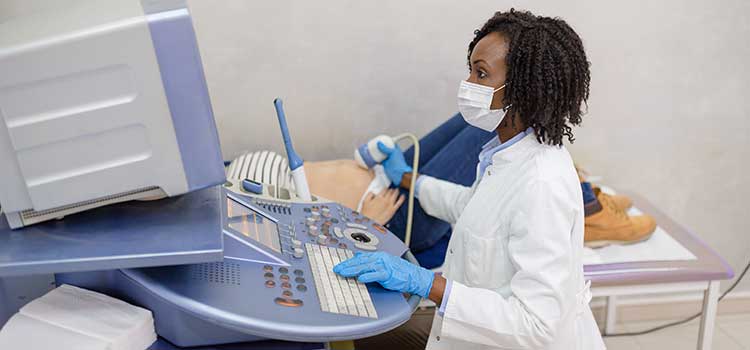
During a sonography program, you’ll gain hands-on experience by working in a hospital or clinic. Working sonographers will help train you on the job so you can put into practice all you have learned in the classroom. If you have influence over what kind of clinicals you do, aim to get as much variety as possible. “That way, you’ll know if you like certain types of work or procedures,” Scrivens said.
Consider earning a certification.

Most employers, especially those in competitive markets such as large cities and high-paying areas, require certification. In fact, the more credentials you earn, the more you can stand out in a field of candidates. Gaining certification in several sonography specialties can make you more versatile and widen your job prospects.
What do sonographers/ultrasound techs do?
Sonographers are responsible for operating equipment that produces and records images or conducts tests. These images are then used by physicians to make a diagnosis.
Most people are familiar with the role of a sonographer as it relates to pregnancy, but sonograms are also used to examine breast tissue, the brain and spinal cord, muscles, ligaments, tendons and joints, and organs in the abdominal cavity.
Like other allied health careers, you can specialize as a sonographer. For example, cardiac sonographers produce images of a patient’s heart, heart chambers, valves and vessels. A vascular sonographer focuses primarily on blood vessels and blood flow.
But a sonographer’s job requires more than just producing an image. You’ll interact with patients by preparing them for the procedure. You’ll also need a keen eye because sonographers must be able to recognize normal and abnormal images. Analyzing diagnostic information and providing it to the physician is another regular task.
All in all, typical job duties for sonographers include:
What degree do I need to become a medical sonographer?
There are several education options for sonographers, but one thing is for certain: You need at least an associate degree to become a medical sonographer. It’s also the minimum education needed to qualify for most sonography certifications. An associate degree in medical sonography typically takes about two years of full-time study to complete.
Some schools also offer bachelor’s degrees in medical sonography, which can be a great option for someone interested in management roles. A bachelor’s degree usually takes four years and can offer more opportunities to explore different sonography specialties. If you enter a bachelor’s program with an associate degree, you may be able to transfer some credits toward your bachelor’s, saving time and money.
Certificate programs in medical sonography are also available, but these are professional programs intended for people already working in the healthcare field. They take about 12 to 24 months to complete.
What will I learn in a diagnostic medical sonography program?
Many sonographer programs requiring passing courses in the core sciences—biology, chemistry, anatomy, physiology, physics—as a prerequisite for admission. Some programs prefer applicants with a background in science or experience in another healthcare profession, but many also will consider high school graduates with courses in mathematics and science, as well as applicants with liberal arts backgrounds.
Volunteer and work experience in healthcare can help you stand out among applicants.
In the case of professionals who already have an associate or bachelor’s degree in a healthcare field, a sonography certificate program is an option. Because these students already have a healthcare background, a certificate program focuses specifically on sonography skills.
In a sonography program, you take classes with a cohort. Programs do not typically offer much flexibility to choose electives, so if there’s a specialty you’d like to pursue, you can request that your clinical work includes training in the area.
Diagnostic sonography programs may offer courses in:
As part of your program, you’ll also gain hands-on experience in a clinical externship, typically lasting three to six months.
What to look for in a school
Sonography programs are located throughout the country, but how do you know if the one you choose will give you the education you need? Consider some of the following criteria when comparing colleges:
Accreditation
Look for a sonography program that is accredited by the Commission on Accreditation of Allied Health Education Programs (CAAHEP), the Joint Review Committee on Education in Diagnostic Medical Sonography (JRC-DMS) or regional accrediting agencies. If your school and program are not accredited, you won’t be able to apply for federal financial aid or earn professional certification, which many employers require.
High-tech facilities
As a sonographer, you’ll work with technology and state-of-the-art equipment every day. It’s important to find a school that offers instruction in a high-tech facility.
Once you’ve gained knowledge in the classroom, you’ll want to put your skills to the test with hands-on training. Be sure to tour a school’s facility and learn what type of access you’ll have to the labs on campus.
Externship opportunities
One of the best ways to understand a day in the life of a sonographer is to get out in the field. Look for a school that partners with medical facilities or labs for externships.
Real-life experience is invaluable. You’ll be able to shadow a sonographer, ask questions and learn about the challenges and rewards of the job. No textbook can offer that type of experience.
Traits and skills of successful sonographers
Education is just part of the process of becoming a sonographer. To do the job well, you’ll need a balance of people skills and tech skills. Here are a few to consider.
You are:
You should have:
What’s the salary and job outlook like for sonographers?
According to the U.S. Bureau of Labor Statistics (BLS), the median salary for diagnostic medical sonographers is $89,340. Salaries can range depending on where you work, your experience and other factors. The highest 10% earned more than $123,170, while sonographers in the lowest 10% earned $64,760.
According to the BLS, jobs for diagnostic medical sonographers are expected to increase by 13% through 2034, higher than average for all occupations. This means that now is an excellent time to consider your education and future career.
Career advancement
Employers typically prefer to hire sonographers who have professional certification. You’ll also need to take continuing education courses to keep your certification current throughout your career.
Earning certifications can be a professional advantage because sonographers certified in more than one specialty are expected to have the best opportunities. If you enjoy diagnostic work, you could also pivot into other fields by pursuing a career as a medical and clinical laboratory technologist or technician, a radiology technologist or a nuclear medicine technologist.
Since diagnostic medical sonography is expected to grow at such a rapid pace, now is a great time to earn your education and become part of a thriving healthcare field.
What’s more, you’ll have the personal satisfaction of helping people address potential health problems. “As a sonographer, yes, I love scanning babies,” Scrivens said. “But I find this job rewarding, even in sad cases. You don’t want to find a problem, but if it’s there, you want to find it immediately. It’s good to help patients get what they need.”
Frequently asked questions (FAQ)
What degree do you need to become an ultrasound technician?
Most diagnostic medical sonographers complete an associate degree in diagnostic medical sonography, which typically takes about two years. Some students pursue a bachelor’s degree, or, if they already have a healthcare-related degree, a post-graduate certificate. Many employers prefer graduates of programs accredited by the Commission on Accreditation of Allied Health Education Programs (CAAHEP).
How long does it take to become an ultrasound technician?
Becoming an ultrasound technician usually takes one to four years, depending on your educational path. An associate degree—which is the most common education path—typically takes about two years, while a bachelor’s degree may take four years. Some students with a related healthcare degree can complete a certificate program in about 12–18 months.
Do ultrasound technicians need certification?
Certification is not required in every state, but most employers prefer or require professional credentials. Many sonographers earn certification through the American Registry for Diagnostic Medical Sonography (ARDMS) or the American Registry of Radiologic Technologists (ARRT).
What specialties can ultrasound technicians choose?
Many sonographers specialize in a particular area of imaging. Common specialties include abdominal sonography, obstetric and gynecologic sonography, cardiac sonography (echocardiography), vascular sonography and breast sonography. Specializing often requires passing a corresponding credentialing exam.
What is the difference between a sonographer and an ultrasound technician?
The terms sonographer, diagnostic medical sonographer, and ultrasound technician generally refer to the same profession. “Sonographer” is the more formal healthcare title, while “ultrasound tech” is a common term used informally.