
In this Article

By: All Allied Health Staff
Updated: March 12, 2026
Dental hygienist career snapshot
What does a dental hygienist do?
Never before have dental hygienists had so many opportunities for their education and careers. With training that can be found in person and online, as well as work settings that go beyond the traditional clinic, there are more options than ever for launching your career. If you’re interested in joining this rapidly growing field, read on to learn the steps you need to take to become a licensed dental hygienist.
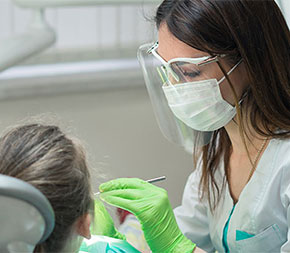
Working side-by-side with a dentist, a dental hygienist’s primary concern is with the preventative oral healthcare of their patients. They clean teeth, examine gums, collect medical history and educate their patients on oral care techniques.
Dental hygienist duties
Specific job responsibilities of dental hygienists include:
Dental hygienist vs. dental assistant
Dental hygienists and dental assistants may sound like the same thing, but their positions aren’t interchangeable. While assistants might take on some of the same tasks as hygienists, their roles are more focused on helping the office run smoothly through administrative and maintenance duties. Daily responsibilities might include:
- Scheduling appointments and keeping records
- Getting patients comfortable in the dental chair
- Sterilizing dental equipment
- Setting up tools and restocking materials
- Handing instruments to the dentist during procedures
- Handling patient billing and payments
In some cases, dental assistants are allowed to take on extra responsibilities, however, each state regulates these on its own. You may find that dental assistants have additional duties such as:
- Polishing teeth to remove plaque and stains
- Applying fluoride and sealants to protect against cavities
- Administering topical anesthesia
Learn how to become a dental hygienist in 6 steps
Keep in mind that the process for becoming a dental hygienist varies slightly from state to state. Use this as a general framework for how to become a dental hygienist, and be sure to check with your local laws for more information.
Earn your high school diploma or GED.

Before enrolling in any dental program, you’ll need to complete your high school education or a GED first.
Apply to a CODA-accredited dental hygiene program.

For most people entering the field, you have the option to pursue either an associate degree or bachelor’s degree in dental hygiene. It’s common for some schools to require you to apply to the school first before the program itself. Then, you must pass certain prerequisite courses before you can apply to the actual program. Make sure your program is accredited by the Commission on Dental Accreditation (CODA).
Pass the NBDHE exam.

Every state requires dental hygiene applicants to take and pass the National Board Dental Hygiene Examination (NBDHE) administered by the Joint Commission on National Dental Examinations (JCNDE).
Pass your state’s clinical exams.

In addition to the national licensing exam, states also require you to pass a clinical examination in order to test your skills. You may also need to complete a background check or a jurisprudence exam prior to applying for licensure.
Apply for a license and look for jobs.

Once you’ve completed your state’s licensing requirements, you can apply for a license and look for jobs once licensure has been granted.
Maintain your license.

You’ll need to complete ongoing continuing education requirements in order to keep your dental hygienist license active.
Dental hygienist education requirements
All states require dental hygienists to be licensed, though the specific requirements vary by state. That said, the minimum level of education you need to earn your license in any state is an associate degree. Depending on your career goals, you might choose to pursue a bachelor’s or master’s degree instead.
Accreditation
No matter which degree you choose, becoming a licensed hygienist requires attending a program that’s been approved by the Commission on Dental Accreditation (CODA). Accredited dental hygiene programs have demonstrated that they meet the highest quality standards for education and therefore help ensure future patient safety.
What you’ll study
According to CODA, all accredited programs must cover four key content areas—general education, biomedical sciences, dental sciences and dental hygiene science. These are further broken down into more concentrated topics:
| General education | Oral and written communication, psychology and sociology |
| Biomedical science | Anatomy, physiology, chemistry, biochemistry, microbiology, immunology, pathology and/or pathophysiology, nutrition and pharmacology |
| Dental science | Tooth morphology, oral embryology and histology, oral pathology, radiography, periodontology, pain management and dental materials |
| Dental hygiene science | Oral health education and preventative counseling, health promotion, patient management, community oral health, medical and dental emergencies, infection and hazard control, clinical dental hygiene, provision of services for patients with special needs and bloodborne diseases and the legal and ethical principles of dental hygiene practice |
These apply to all levels of degrees, though if you choose to pursue an advanced degree, you might tailor your education even further. You could dive deeper into areas such as systemic dental conditions, dental health theory and research or pediatric oral health.
Dental hygiene degree options
The minimum level of education for a dental hygienist is an associate degree, though bachelor’s and master’s degrees are also options for those who want to move up in the field. The length of time it takes to complete your education depends on the degree you choose.
Associate degree
Associate degrees provide you with the necessary level of education that’s required for licensing. Community and technical colleges offer these programs and most take about two years to complete. They are the most common education route for people entering the field.
Along with classroom coursework that covers the topics outlined by CODA, you’ll also complete supervised clinical experience over the course of your program. Most programs start out with more classroom-based learning that gradually ramps up to hands-on clinical practice closer to the end.
Admissions requirements
Admission requirements for any dental hygiene program is dependent on the school. However, many programs require the completion of certain prerequisite courses with a GPA of 2.5 or higher. These might include courses in subjects such as:
- English
- Anatomy and physiology
- Biology
- Chemistry
- General psychology
Bachelor’s degree
Though not as common, bachelor’s degree programs are designed for dental hygienists who are interested in more specialized care, like practicing or developing programs within public health or school settings.
Bachelor’s degrees typically take four years to complete, though you can earn one in less time by entering with an associate degree. Known as degree-completion programs, these are designed for students who either already have their dental hygiene license and want to advance their skills, or they have an associate degree in another field that satisfies the prerequisites courses.
Admissions requirements
You’ll likely need to meet prerequisites and have a GPA of 2.5 or higher. High school graduates should have taken the same courses that are needed to enter an associate program, while those who already have an associate degree should have knowledge in areas such as anatomy, radiology and dental lab materials.
Master’s degree
If you’re looking to teach, conduct research or work at an administrative level, a master’s degree in dental hygiene might be the best option to pursue. These degrees could lead to higher-level roles like oral disease prevention specialists, community program directors or leaders of dental health and education programs. Master’s degrees in dental hygiene typically take one to two years and require the completion of a capstone project.
Admissions requirements
Admission into a master’s program requires a bachelor’s degree in dental hygiene or a related field that covers the necessary prerequisites. Other common admission requirements include:
- A GPA or 3.0 or higher
- Proof of a current dental hygienist license
- Acceptable scores on the GRE
- Letters of recommendation
- Possible career statement or current resume
Online dental hygienist programs
Online programs do exist, but keep in mind that dental hygiene is a hands-on field. You might be able to enjoy the flexibility of taking basic courses online, but you’ll still need to complete in-person clinical experience to prepare you for the duties of the role.
The exception to this rule could be a degree-completion program. Since you enter this type of program having already completed your clinical experience while earning your associate’s degree, it could be possible to earn your bachelor’s entirely online.
Licensing requirements for dental hygienists
Dental hygienists must be licensed by the state where they work. After graduation from an accredited program, you’ll need to take and pass the National Board Dental Hygiene Examination, administered by the Joint Commission on National Dental Examinations (JCNDE). The test consists of 350 multiple-choice questions and is scored on a scale of 49–99, with 75 being the minimum score for passing.
Each state also has its own clinical-based exam, which tests your knowledge of basic hygiene procedures, anesthesia and restorative techniques. Additionally, it’s common to be required to take a drug and law exam that covers the rules and regulations that are specific to your state. Passing all necessary exams allows you to earn your license as a registered dental hygienist (RDH).
Dental hygiene license renewal
Dental hygienists are required to renew their license, typically every one to three years. You’ll need to pay any necessary fees and provide proof that you’ve completed the required number of continuing education hours as determined by your state. These are often somewhere between 10 and 20 hours for every one-year cycle, 30–50 hours for two-year cycles and around 60 for three-year cycles. The topics you’ll need to cover will vary by state, though most require classes in CPR and infection control.
The American Dental Association (ADA) offers countless ways for you to earn your continuing education hours. You can search through a database of both live and online courses that cover a variety of topics.
Finding dental hygienist jobs
Along with continuing education, the ADA also offers resources to help you find a job. Through the online ADA CareerCenter, you can search by job title, location, salary, company and more to find opportunities that meet your unique needs. Jobs are posted directly to the CareerCenter and are also pulled in from outside job listing websites to make it easy to find openings all in 1 place.
How much do dental hygienists make?
According to the U.S. Bureau of Labor Statistics (BLS), dental hygienist annual salaries are dependent on a number of factors including the exact position, your level of education, amount of experience and the setting in which you work. Entry-level hygienists in dental offices may earn less, while those in research, teaching or corporate positions will likely earn more.
Compare dental hygienist salaries by state and see what you may earn where you live:
Salary compared to other dental careers
Discover how a dental hygienist’s salary compares to the pay of dental assistants for example, and other adjacent occupations.
Other benefits
Along with competitive salaries, dental hygienists enjoy other benefits, including plenty of opportunities to find jobs. The BLS predicts that the demand for dental hygienists will increase by 7% through 2034, faster than average for all jobs.
What’s more, dental hygienists often have the chance to take advantage of flexible schedules. In fact, roughly half of all dental hygienists work part time while still earning above average salaries.
Career growth pathways
After completion of a dental hygiene program, dental hygienists can choose to pursue additional training in such areas as education, business administration, marketing and public health. Gaining this additional knowledge can help you find more specialized, high-level roles while increasing your earning potential.
Dental hygienist to dentist
After working in the field, you might decide you want to remove the “hygienist” from your title and become a full-fledged dentist. To do so, the most common path is to start with a bachelor’s degree in dental hygiene. With this degree, you can apply for a four-year doctoral program to pursue a Doctor of Dental Medicine (DMD) or Doctor of Dental Surgery (DDS). Most schools require you to complete prerequisites in biology, chemistry, physics and English and take the Dental Admission Test before you can apply.
If you don’t yet have your bachelor’s, you can earn one through a degree-completion program in around 15–18 months. Some dental schools also offer doctoral programs that allow you to earn your bachelor’s while working toward your doctorate. These programs typically take six years to complete, compared to the total eight years it would take to earn your bachelor’s and doctorate separately.
With a DMD or DDS in hand, you can sit for your state-required written and clinical exams in order to earn your license and be able to practice as an independent dentist. Use our handy Find Schools widget on this page to find the right dental hygienist school near you if you’re ready to take action.
Frequently asked questions (FAQ)
How long does it take to become a dental assistant?
For most new hygienists, it takes about two years of full-time study to complete an associate degree program and earn their dental hygiene license. If you decide to pursue a bachelor’s or master’s degree, it could take longer.
Do dental hygienists need a license in every state?
Yes, dental hygienists must be licensed in every state before they can practice. While requirements vary slightly, most states require candidates to graduate from an accredited dental hygiene program, pass the National Board Dental Hygiene Examination and complete a regional or state clinical exam.
Are dental hygiene programs competitive?
Dental hygiene programs can be competitive because many schools limit class sizes due to clinical training requirements. Applicants may need to complete prerequisite science courses such as biology and anatomy and maintain a strong GPA to be admitted.
What degree do you need to become a dental hygienist?
Most dental hygienists earn an associate degree in dental hygiene from a CODA-accredited program. Some students choose to pursue a bachelor’s degree, which may open the door to roles in education, research, or public health. All programs must be accredited to qualify graduates for licensure.
What is the difference between a dental hygienist and a dental assistant?
Dental hygienists primarily provide preventive oral care, including cleaning teeth, examining gums and educating patients about oral hygiene. Dental assistants typically support dentists during procedures, prepare instruments, manage patient records and handle administrative tasks in the dental office.