
In this Article


By: All Allied Health Staff
A radiology technician, also known as a radiologic technologist or radiographer, specializes in performing diagnostic imaging procedures on patients. They utilize various techniques, including X-rays and magnetic resonance imaging (MRI), to create detailed diagnostic images that aid in the diagnosis and treatment of medical conditions.
Key takeaways
- Radiology technologists are essential healthcare workers who perform diagnostic imaging procedures like X-rays and MRIs to help physicians diagnose and treat medical conditions.
- You can earn a certificate, associate degree or bachelor’s degree in radiologic technology, but you’ll need at least an associate degree to qualify for most industry certifications.
- Radiology technologists can specialize in different imaging disciplines such as mammography, radiation therapy, sonography and more.
Learn how to become a radiology technologist in 4 steps
These steps offer a basic framework to guide your education decisions.
Earn your high school diploma or GED.

You’ll need a high school education to apply to radiology technology programs.
Earn a degree.

You can choose from a certificate, associate degree or bachelor’s degree in radiology technology. An associate degree is the most common education route.
Earn certification.

You’ll need to attend an accredited program to earn certification, which most states and employers require.
Consider specializing.
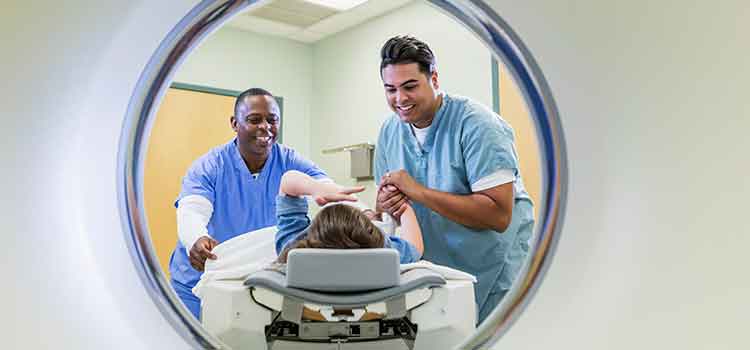
As a radiology technician, you’ll likely start your career taking X-rays. But there are many specialty certifications that will qualify you to branch out into other imaging procedures, including sonography, MRI and mammography.
What do radiology technologists do?
Radiology technologists—also known as radiologic technologists and radiographers—play a key role in helping to identify conditions such as cancer, ulcers or broken bones. They operate imaging equipment and help position patients to get the clearest images possible. Physicians can then use these images to diagnose and treat patients’ medical conditions. As a radiology technologist, you must be aware of radiation safety measures and protection to comply with government regulations and ensure the safety of both the patients and yourself.
“Radiologic technologists make up the third-largest group of health care professionals—surpassed in number only by physicians and nurses,” says the American Registry of Radiologic Technologists (ARRT).
“Registered radiologic technologists (R.T.s) are medical personnel who perform diagnostic imaging examinations and administer radiation therapy treatments. R.T.s practice in hospitals, clinics and physician’s offices, and in many clinical specialties, from prenatal care to orthopedics. They are educated in anatomy, patient positioning, examination techniques, equipment protocols, radiation safety and patient care,” says the American Society of Radiologic Technologists (ASRT).
As radiology technologists gain experience over time, they can also choose to specialize in certain types of imaging—such as mammography, sonography, computed tomography (CT) and more—and pursue specialty certifications to validate their skills.
Where do radiology techs work?
Radiology techs work in a variety of healthcare settings, including:
What education do you need to become a radiology tech?
There are formal education programs in radiography that lead to a certificate, associate degree or a bachelor’s degree. Each of these education routes can lead to different career outcomes. The associate degree program is the most common because it is the minimum education needed to qualify for the Registered Technologist (R.T.) credential from the ARRT. It takes about two years to complete, while a bachelor’s degree usually takes four years.
All radiology programs include classroom and clinical training. You can expect to study the following subjects:
One thing to consider when choosing any school and program is accreditation, which is a seal of approval for your curriculum. Accredited schools have been reviewed by professional associations, subject matter experts and regional accreditation agencies to make sure they provide a quality education.
Certificate vs Certification
- Certificate
- A certificate is awarded by an educational institution, and signifies that a student has satisfactorily completed a given curriculum. Certificate programs can help students prepare for certification exams.
- Certification
- A certification is generally awarded by a trade group after an individual has met certain professional requirements (e.g. earned a specific degree, worked professionally in a given field for a set amount of time, etc.) and passed a certification exam.
In short, a certificate is evidence that someone has completed an educational program, while a certification denotes that someone has met a certain set of professional criteria and/or passed an exam.
Not all programs offered are designed to meet state educator licensing or advancement requirements; however, it may assist candidates in gaining these approvals in their state of residence depending on those requirements. Contact the state board of education in the applicable state(s) for requirements.
Essential skills for radiology techs
Radiology technologists work with patients who may be anxious or fearful about imaging procedures or their current health concerns. Being able to help patients move through a procedure with as much ease as possible is the mark of a good radiology tech.
These personality traits and skills may help you succeed as a radiology technologist.
You are:
- An active listener
- Compassionate
- A clear communicator
- Comfortable working with the public
- A problem solver
You have:
- Excellent customer service skills
- Time management skills
- A knack for critical thinking
- Patience
- Attention to detail
Salary and job outlook for radiology techs
According to recent BLS data, the median annual salary for radiology technologists is $77,660.
Salaries can range depending on where you work, however. The top 10% of radiology technologists earn more than $106,990, with the highest earners typically working in outpatient care centers, according to the BLS.
Jobs for radiology technologists are expected to grow by 4.3% through 2034, in line with the growth projected for all other occupations combined. This means that now could be a promising time to become a radiology tech.
Radiology tech licensing and certification
Most states require radiology technologists to be licensed, and the vast majority require them to earn the Registered Technologist (R.T.) certification from the ARRT. The R.T. credential can be earned in multiple different disciplines—the most common is the general Radiography (R) discipline. It requires graduating from an accredited program and passing a certification exam.
As a rule, employers usually expect job candidates to have the R.T. certification, so it’s a good idea to plan on pursuing this credential.
“More than 75% of states have licensing laws covering the practice of radiologic technology. In those states, you must obtain a state license before you can work as an I.A., R.T., or R.R.A. In addition, many states use ARRT exam scores and/or credentials when making licensing decisions. In other words, some—but not all—states require you to be certified and registered through ARRT before you can obtain a state license,” ARRT says.
To maintain their certification, radiologic technologists must complete 24 continuing education units every two years. This education can include things like online classes, self-study readings, lectures at professional society meetings and classroom learning.
As you build your career, certifications can help you specialize in a specific type of imaging, such as nuclear medicine, ultrasounds, cardiovascular sonography and more.
Here are some of the other certifications available to radiology technologists from the ARRT:
Sonography (S)
Computed Tomography (CT)
Mammography (M)