


By: All Allied Health Staff
Updated: June 11, 2026
Key Takeaways
- To become a licensed physical therapist in the U.S., you must earn a Doctor of Physical Therapy (DPT) degree after completing a bachelor’s degree.
- Physical therapy programs include associate degrees, bachelor’s-to-master’s, direct entry master’s, direct entry doctorate and transitional DPT options.
- Students should focus on science and health courses during their bachelor’s degree to meet prerequisites for graduate programs.
- Graduates must pass the National Physical Therapist Examination (NPTE) to obtain licensure and may pursue advanced certifications.
Learn About the Many Physical Therapy Degree Programs
Once you’ve decided a career in physical therapy is for you, you’ll need to assess the many physical therapy degree programs available. Because there are several career paths you can take, it’s important to understand what’s required to begin your practice, and what physical therapy degrees will help you stay ahead of the competition and earn the salary you want.
Today, anyone who wants to become a physical therapist in the U.S. needs a Doctor of Physical Therapy (DPT) degree. Before they can start their DPT program, you need a bachelor’s degree from an accredited 4-year college or university first. For students who have already earned a bachelor’s degree and have taken the appropriate prerequisites in chemistry, biology, and physics, a DPT program can take as few as 2-1/2 years.
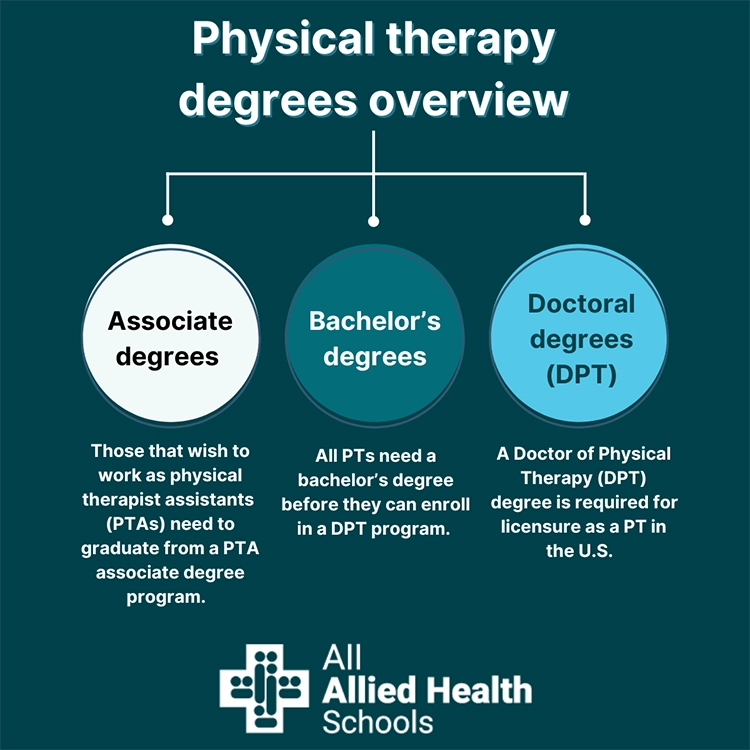
Available Physical Therapy Degree Programs
| Degree Type | About the Program |
|---|---|
| Associate Degree | Physical therapy assistants must earn a 2-year associate degree in order to practice. In addition to the theory and practice of physical therapy, you’ll study the basic medical sciences, general education courses and gain hands-on experience in a clinical internship. |
| Bachelor’s-to-Master’s | These joint bachelor’s/master’s physical therapy degree programs allow you to earn both degrees on an accelerated schedule. Since a DPT degree has become the minimum education required for licensure as a physical therapist, these programs have been phasing out. |
| Direct Entry Masters (MPT) | These physical therapy degrees give students credit for having completed their liberal arts requirements and combine preparation for licensure with advanced training in a master’s specialty area. Direct entry MPT programs typically take 2-to-3 years to complete, with the first year being devoted to entry-level coursework and the last year to clinical practice. Since a DPT degree has become the minimum education required for licensure as a physical therapist, these programs have been phasing out. |
| Direct Entry Doctorate (DPT) | DPT programs prepare graduates with bachelor’s degrees in other fields for entry into the PT profession. Most programs can be completed in three years. |
| Transitional DPT | A two year doctorate program developed specifically for practicing PTs who want to “bridge the gap” between their certificate, bachelor’s or master’s degrees in physical therapy and earn their Doctor of Physical Therapy degree. |
Bachelor’s Degree Programs
The first step toward earning your postgraduate professional degree is to complete a bachelor’s degree program. During the course of your 4-year program, focus on taking as many science and health-based classes as possible. Some graduate programs’ prerequisites include a certain amount of coursework in these areas.
Courses in a Bachelor’s PT Program
Master’s Degree Programs
Master’s degree programs in physical therapy have been phasing out and/or transitioned to a doctoral level program. That’s because you now need a DPT degree in order to qualify for licensure as a physical therapist in the U.S.
Doctorate Programs
A DPT program is designed to give you the expertise to be a successful physical therapist. Your time will be spent both on coursework and in clinical practicum.
As an example of course work, the University of New England’s DPT program includes the following classes:
Courses in a Doctoral PT Program
Getting Into the School of Your Choice
Admission to physical therapy programs is competitive; to get into your school of choice, you’ll need to accomplish the following:
What You’ll Study
Curriculum varies from program to program, but in addition to the theory and practice of physical therapy, your physical therapy courses will likely cover:
You’ll also gain plenty of hands-on experience in a clinical internship.
What Accreditation is There For My Program?
Accreditation is the seal of a approval that a school or program meets the highest standards set by an accrediting organization. Without accreditation, a school isn’t eligible for federally-funded and state entitlement programs, like financial aid. As a student, attending a non-accredited school can hinder your future education plans. Many accredited schools will not accept credits or coursework from a non-accredited institution. This means if you were to earn a bachelor’s degree from a non-accredited school, you may not be accepted into a DPT program at an accredited institution.
Physical therapy programs and schools should be accredited by the Commission on Accreditation in Physical Therapy Education (CAPTE).
Getting Your License
After graduating from an accredited physical therapy program, you must then pass the National Physical Therapist Examination (NPTE). Some people choose to seek advanced certification in a clinical specialty, while others become certified in electrophysiological testing and measurement.